
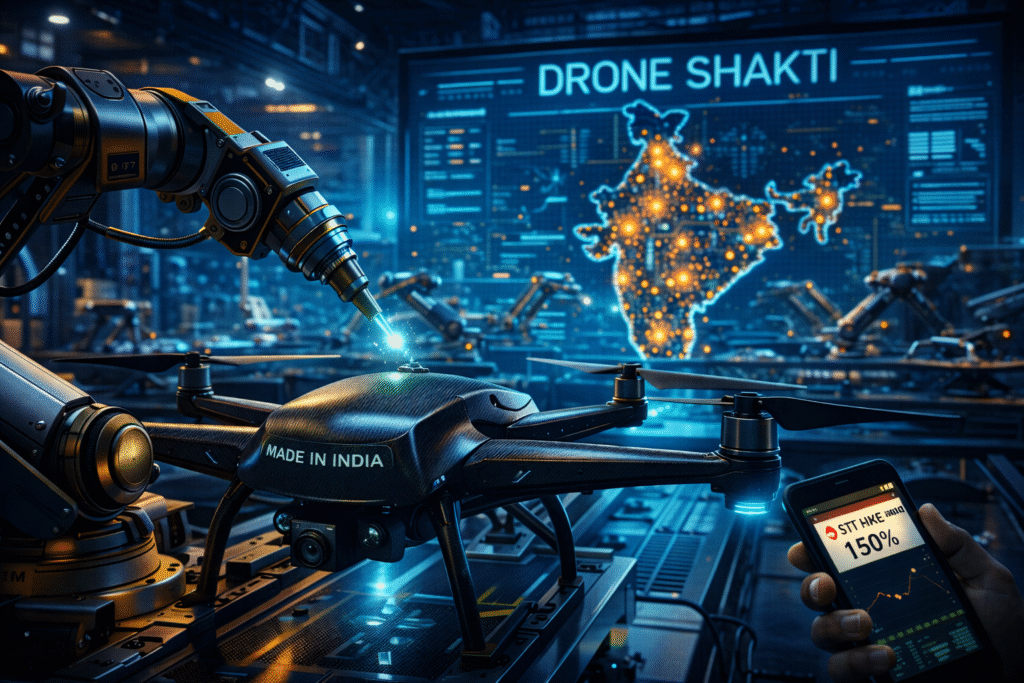
In 2021, the Indian drone industry was effectively grounded by red tape and a near-total ban on flying in most zones. Fast forward to February 2026, and the scene is unrecognizable. While the world watched the Union Budget for tax cuts, a quiet ₹10,000 Crore allocation for the “Drone Shakti Mission” has sent aerospace stocks like IdeaForge soaring by 4.6% in a single session.
This isn’t just about “flying cameras” anymore. India has pivoted from being an importer of Chinese parts to building EW-resilient (Electronic Warfare) autonomous systems that are now essential for national security and the $23 Billion manufacturing opportunity by 2030.
The Problem: The “Assembly-Only” Trap
The ground reality for years was that Indian drone companies were “manufacturers” in name only. Against all odds, they fought a lopsided battle where 70-80% of components—from flight controllers to high-energy density batteries—were sourced from Shenzhen.
This created a massive strategic risk. If a border conflict intensified, the supply chain for tactical drones could be cut off overnight. Furthermore, the high cost of imported sensors meant that drone services in agriculture were too expensive for the average Indian farmer to adopt at scale. The industry was stuck in a “Pilot Project” loop, unable to cross the chasm into mass deployment.
The Pivot/Strategy: The “Drone Shakti” Blueprint
The Indian government and leading startups realized that to win, they had to move from Drone-as-a-Service to Deep-Tech Sovereignty. Budget 2026 introduced a two-tier subsidy structure that changed the game:
- Capex Support: A 10-15% subsidy for setting up indigenous manufacturing units for motors, sensors, and flight controllers.
- Output-Linked Incentives: A secondary layer of incentives focused on Design-Linked Innovation (DLI), rewarding companies that own their Intellectual Property (IP) rather than just assembling parts.
IdeaForge pivoted by focusing on “all-weather” and “man-portable” drones like the SWITCH and ZOLT, which can operate in GPS-denied environments. Garuda Aerospace, meanwhile, scaled by creating a “Drone-as-a-Service” fleet for 10,000+ villages, democratizing precision agriculture through the Kisan Drone initiative.
The Unit Economics: From Burn to Scale
The industry is moving from “lumpy” one-time government orders to recurring revenue models.
| Metric | Pre-2022 (The “Pilot” Era) | Budget 2026 Scale (Current) |
| Total Industry Funding | ~$30M – $50M | $179M+ (2025-26) |
| Indigenous Component % | 15% – 20% | 55% – 65% |
| Order Book (IdeaForge) | < ₹100 Crore | ₹368 Crore+ |
| Daily Drone Sorties (Agri) | Under 100 | 10,000+ (Nationwide) |
| Govt. Support Scheme | Fragmented PLI | ₹10,000 Cr Drone Shakti |
The “ForgeUp” Analysis: Why This Model Worked
From a venture studio perspective, the “Drone Shakti” model is brilliant because it tackles Capital Intensity and Market Demand simultaneously.
By mandating 50-60% domestic content, the government has forced a “forced evolution” of the local supply chain. This is the “Venture Studio” approach at a national level: providing the infrastructure (Digital Sky platform), the capital (incentives), and the first big customer (Defence and Agriculture ministries).
Startups that succeeded didn’t just build hardware; they built ecosystems. They created training centers for “Drone Pilots” and repair hubs in Tier-2 cities, ensuring that a broken drone doesn’t mean a dead business.
Expert Consensus: What the Industry Says
“The shift from being a ‘user’ of technology to a ‘builder’ of technology is now complete. Budget 2026 provides the fiscal certainty we need to invest in R&D for the next decade.” — Ankit Mehta, CEO of IdeaForge.
“We are no longer just looking at the Indian market. With the ‘Make in India’ tag and proven field performance in the Himalayas, our drones are now ready for global exports.” — Agnishwar Jayaprakash, Founder of Garuda Aerospace.
Internal Linking
Want to stay updated on the next big sector ripe for disruption? [Link to your related Startup News or Venture Studio service here] for deep-dives into Spacetech and AI.
💡 Founder’s Playbook: 3 Actionable Steps
- Focus on “Indigenization” Early: Don’t just white-label Chinese products. The government and big VCs are now only betting on startups that own their “Core IP.”
- Build for “Dual-Use”: A drone that can map a farm can also monitor a border. Designing for both civil and military use cases doubles your Total Addressable Market (TAM).
- Invest in Software Resilience: In 2026, the hardware is a commodity. The real value lies in AI-driven autonomous navigation and EW-resilient communication stacks.
The Bottom Line
The “Drone Shakti” mission is the final push needed to move India’s drone startups from the “experimental” phase to “national infrastructure.” By aligning fiscal policy with strategic indigenization, India isn’t just catching up to global leaders—it’s building a specialized, resilient UAV ecosystem that is uniquely suited for the “contested” environments of the future.