
Synopsis: Hindustan Unilever Ltd (NSE: HINDUNILVR) announced a strategic investment of up to ₹2,000 crore on February 18, 2026. The “Zero-Minute” fact is that this capital will be deployed over two years to expand manufacturing for high-growth premium Beauty, Wellbeing, and Home Care liquids, leveraging advanced automation to serve fast-scaling Quick Commerce and D2C channels.
On Wednesday, February 18, 2026, Hindustan Unilever Limited (HUL) approved a massive ₹2,000 crore capital expenditure plan aimed at future-proofing its manufacturing backbone. This move follows a strong Q3 FY26 performance where the company reported a 4.3% revenue growth and a standalone net profit of ₹7,075 crore (aided by one-off gains from the ice cream demerger). Under CEO Priya Nair, HUL is pivoting from mass-market volume battles to a high-margin “Premiumization” model to capture India’s rising aspirational demand.
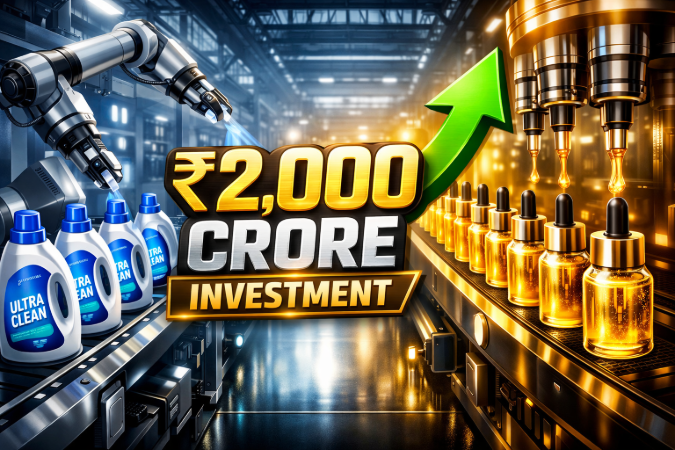
The investment is spread across multiple locations and is designed to enhance supply-chain agility. By integrating AI, machine learning, and digital twins into its new facilities, HUL aims to reduce product changeover times and support a three-fold increase in product variants, specifically for “Channels of the Future” like Quick Commerce, which now accounts for 3% of its total sales.
Why is HUL investing ₹2,000 crore in “Premium” now?
The primary driver is the Structural Shift in Indian Consumption. As rural and urban disposable incomes rise, consumers are upgrading from bars to liquids and from basic to “actives-led” skincare. HUL’s Home Care liquids (like Surf Excel Matics and Comfort) and Beauty & Wellbeing brands (like Lakmé, TRESemmé, and recently acquired Minimalist) are growing significantly faster than their mass-market counterparts.
Furthermore, the “1-2-1” rule of this expansion is evident: one dominant investment target (Premium Liquids & Beauty), two strategic pillars (Advanced Automation and 100% Renewable Energy), and one clear goal: Volume-led revenue growth. The company’s “Fewer, Bigger Bets” philosophy ensures that capital is not thinned out across stagnant categories but concentrated on high-EBITDA demand spaces like premium skincare and haircare.
HUL Premiumization Roadmap: Key Investment Areas
| Category | Key Brands Involved | Focus Area | Technology Integration |
| Beauty & Wellbeing | Lakmé, TRESemmé, Vaseline | Actives-led skincare & Haircare | AI-driven autonomous troubleshooting |
| Home Care | Surf Excel, Comfort, Vim | Liquid detergents & household care | Digital twins for supply chain agility |
| Health & Wellbeing | Minimalist, Oziva, Horlicks | Premium nutrition & D2C scale | Real-time demand sensing |
The “Sustainability and Digital” Moat
HUL is not just building capacity; it is building a “Future-Ready” network.
- 100% Renewable Energy: In line with its climate-aligned growth, all new facilities under this ₹2,000 crore outlay are targeted to operate on 100% renewable energy, following the “Zero-Carbon” success of its Sumerpur factory.
- Quick Commerce Dedicated Organization: To support the “Instant Shopping” trend, HUL has set up a dedicated business unit where heads report directly to the Sales Head, ensuring that premium stock is always available for 10-minute delivery platforms.
- Technical Outlook: While the stock ended slightly lower at ₹2,324 following the news, analysts maintain a “Hold/Add” rating. The consensus is that while margin expansion is limited (22.5–23.5% range), the revenue CAGR is expected to jump from low single digits to 8% by FY28.
Also Read: GE Power India Share Price Hits 20% Upper Circuit: Why Q3 Profits Surged 123%
The Bottom Line
The ₹2,000 crore premium push confirms that HUL is done playing the “discount game” in rural markets. For the Aam Aadmi investor, the focus remains on the FY27 growth outlook, which management projects to be better than FY26. As the company exits the ice cream business and doubles down on Beauty & Wellbeing, it is transforming into a leaner, high-margin technology-led FMCG powerhouse.