
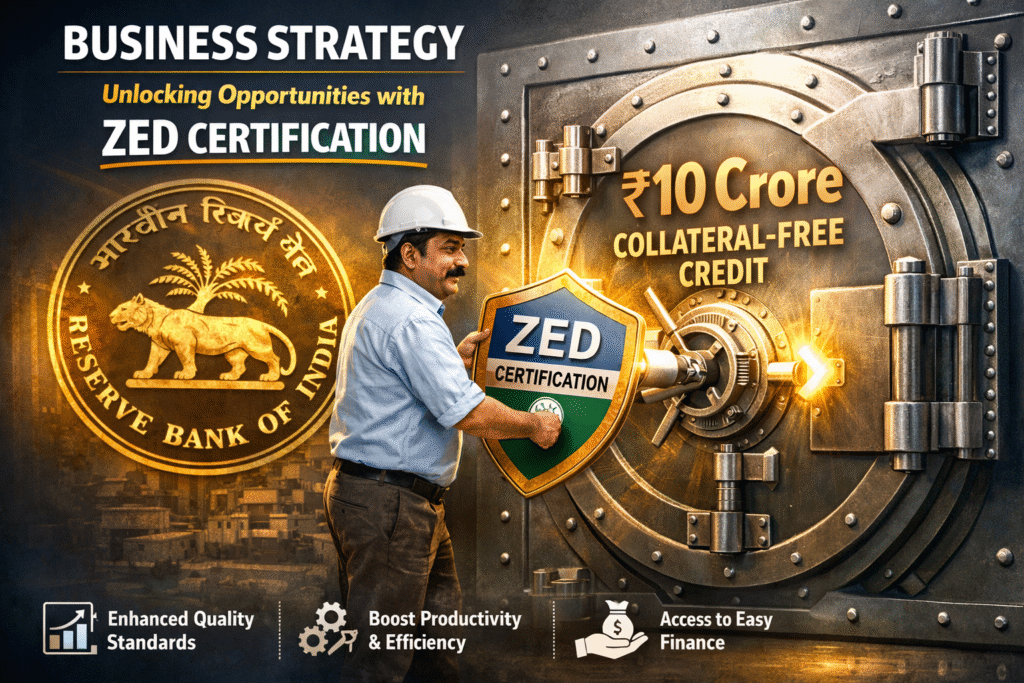
On February 14, 2026, the Indian MSME and Startup ecosystem is witnessing a shift led by the Reserve Bank of India (RBI) and CGTMSE’s decision to double collateral-free limits. With the new ceiling for MSMEs raised to ₹10 Crore and Startups to ₹20 Crore, the strategy offers a masterclass in risk-sharing—yet, it has also introduced a paradox: more capital is available, but the “Approval Gate” has become narrower.
The Market Gap: The “Collateral Paradox” of 2026
For years, the “Last Mile” problem for Indian founders was the lack of physical assets (land or gold) to pledge against growth capital. The 2026 reforms bridge this gap by transitioning from Asset-Based Lending to Cash-Flow-Based Lending. However, a new gap has emerged: banks are no longer just looking at what you own, but at the absolute transparency of your Udyam and GST data. If your digital “Unit Economics” don’t match your loan request, your application will be denied, even with a government guarantee.
The Unit Economics: 2025 vs. 2026 Guarantee Framework
The following table outlines the significant jump in coverage and the cost of borrowing under the new “Atmanirbhar” focus.
| Loan Feature | Old Model (2025) | New 2026 Framework | Impact on Borrower |
| MSME Limit | ₹5 Crore | ₹10 Crore | 2x Higher Scalability |
| Startup (CGSS) Limit | ₹10 Crore | ₹20 Crore | Supports Series A/B Debt |
| Min. Collateral-Free | ₹10 Lakh | ₹20 Lakh (Mandatory) | No collateral up to ₹20L |
| Annual Guarantee Fee | 1.35% – 2.0% | 0.37% – 1.0% | ~50% Lower Fee Cost |
The “ForgeUp” Strategic Audit: Why Banks are Still Hesitant
Despite the government covering up to 90% of the risk for women-led and ZED-certified units, our audit shows that banks are denying loans due to “Incomplete Digital Footprints.”
- The “ZED” Advantage: Units with Zero Defect Zero Effect (ZED) certification now enjoy a 90% guarantee cover. If you aren’t certified, banks perceive a 25% risk (under the general category), making them more likely to deny your request.
- The CMR Requirement: For loans above ₹1 Crore, banks now strictly require a Credit Monitoring Report (CMR) score between 1 and 4. A “Thin File” (lack of credit history) is now a leading cause for denial.
- The “Champion Sector” Pivot: The government has slashed fees to 1% for 27 identified “Champion Sectors.” If your business falls outside these (e.g., traditional retail vs. AI-tech), you may face higher scrutiny and slower approval times.
Also Read: Kwality Wall’s Listing on Feb 16: Why 1:1 Demerger Ratio and ₹55 Target Triggered Market Buzz
FAQ / People Also Ask
- Does the government pay my loan if I default?No. The guarantee is for the bank. If you default, the CGTMSE pays the bank 75–90% of the loss, but the bank will still initiate legal recovery proceedings against you and your business assets.
- Can I get a ₹20 Lakh loan with zero collateral?Yes. Per the RBI Lending to MSME (Amendment) Directions, 2026, banks are strictly prohibited from asking for collateral for loans up to ₹20 Lakh.
- What is the “Hybrid” Security model?You can now pledge partial collateral (e.g., a small shop) for a large loan, and the “Gap” (up to ₹10 Crore) will be covered by the CGTMSE guarantee.
The Founder’s Playbook: SECURING the Approval
- Get ZED Certified: This is the single fastest way to move from a 75% guarantee to a 90% guarantee, effectively making you a “Low-Risk” client for any PSU bank.
- Clean Your Udyam Data: Ensure your turnover on the Udyam portal matches your GST filings. Discrepancies here trigger automatic “Data Red Flags” in 2026’s AI-driven underwriting.
- The “6-Month Buffer”: Before applying for a high-limit CGTMSE loan, maintain a consistent cash balance and avoid “Cheque Bounces” for at least two quarters to secure a high CMR rating.
The Bottom Line
- Massive Limits: ₹10Cr for MSMEs and ₹20Cr for Startups redefine “Small Business” growth.
- Data is the New Collateral: Your GST and Udyam history now carry more weight than land documents.
- Cost Efficiency: Lower guarantee fees (starting at 0.37%) make this the cheapest form of unsecured debt in India’s history.