
If you thought the Indian electronics story was just about “assembling” smartphones, the Union Budget 2026 just proved you wrong. The truth is, the government isn’t just asking companies to “Make in India”—it is practically bankrolling the shift from simple assembly to high-end component manufacturing.
The Shocking Blueprint: Doubling the Stakes
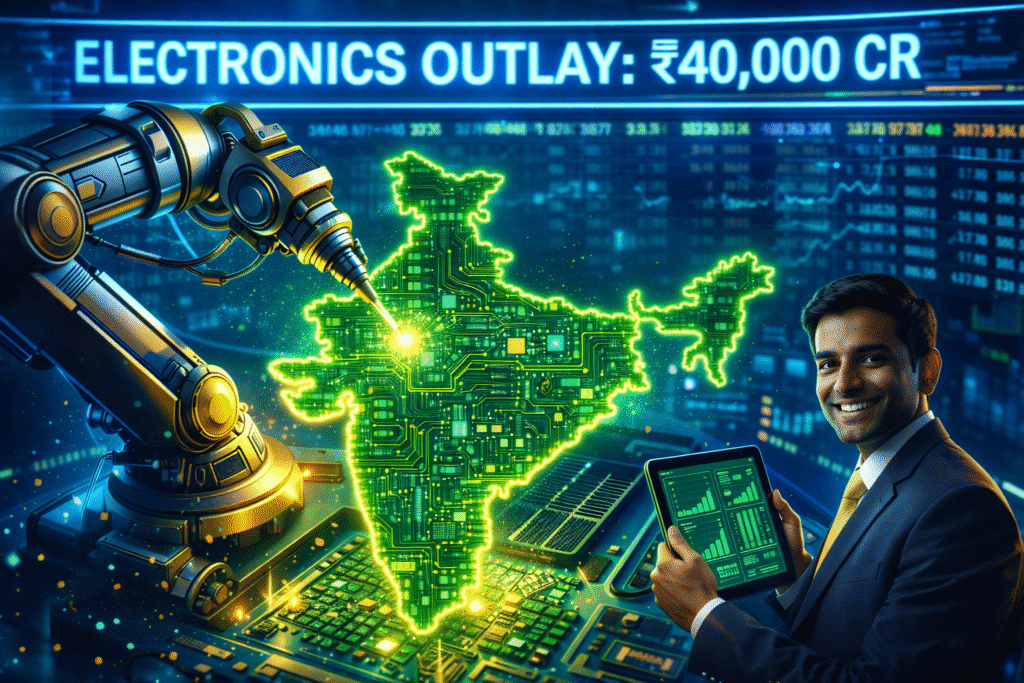
In a move that caught D-Street by surprise, Finance Minister Nirmala Sitharaman doubled the outlay for the Electronics Component Manufacturing Scheme (ECMS) to a massive ₹40,000 Crore. This isn’t just a random number; it is a calculated “Blueprint” to slash our dependence on Chinese imports for parts like PCBAs, camera modules, and display panels.
For the “Common Man” investor, this signals a structural shift. We are moving from “Screw-driver technology” to “Silicon sovereignty.” While the broader market was distracted by the STT hike, the savvy Retail Investor was busy hitting the “Buy” button on EMS (Electronics Manufacturing Services) stocks.
Budget 2026: The Manufacturing Power-Shift
| Feature | Old Outlay (FY 2025) | New Outlay (FY 2026-27) | Strategic Impact |
| Electronics Outlay | ₹22,919 Crore | ₹40,000 Crore | Deep backward integration |
| Semiconductor Mission | ISM 1.0 (Fabs) | ISM 2.0 (Equipments) | Indigenous Chip Ecosystem |
| Customs Duty on Parts | 10-15% | 0-5% (Extended) | Cheaper raw materials |
| Focus Area | Mobile Assembly | Components & IP | Higher Profit Margins |
Also Read: Why the Sensex Plunged 1,500 Points and How to Shield Your Portfolio From a Deeper Slide
How Dixon and Amber Enterprises Win the “Lakh-Crore” Race
Dixon Technologies: The King of Scale
Dixon isn’t just a mobile maker anymore. With the new outlay, their subsidiaries like Kunshan Q Tech are already getting approvals for camera modules. Here’s the catch: manufacturing components offers double the margins of mere assembly. As they move into laptop and display fabrication, their revenue isn’t just growing in Crores; it’s scaling toward the Lakh-Crore league.
Amber Enterprises: The Backward Integration Beast
Amber is the “silent giant” of your living room. They control over 30% of the Room AC manufacturing market. But the real story is their subsidiaries like Ascent Circuits. By securing approvals under the new ₹40,000 Crore scheme for multi-layer PCBs, Amber is ensuring that every circuit board inside an Indian AC or washing machine is “Amber-made.”
Why You Should Watch These 3 “Under-the-Radar” Stocks
While Dixon and Amber grab the headlines, the real “Multibagger” potential in 2026 lies in the companies providing the “shovels” for this gold mine.
- Kaynes Technology: They are the leaders in OSAT (Outsourced Semiconductor Assembly and Test). With the government launching Semiconductor Mission 2.0, Kaynes is perfectly positioned to handle the backend testing of chips made in India.
- Syrma SGS Technology: Focus on them for their high-margin industrial and medical electronics. They recently secured approvals for High-Density Interconnect (HDI) PCBs, which are the brains of modern EVs and 5G phones.
- PG Electroplast: A diversified player that recently saw a 7% surge post-budget. They are the go-to partner for big brands looking to localise their TV and LED manufacturing rapidly.
Pro-Tip: The “Value-Add” Metric
When picking an electronics stock in 2026, don’t just look at Revenue. Look at Domestic Value Addition (DVA). A company moving from 15% DVA to 40% DVA will see its PE ratio re-rated by the market much faster than a pure-play assembler.
The Bottom Line
The ₹40,000 Crore outlay is the government’s way of saying the “China Plus One” strategy is now “India First.” For investors, the message is clear: the volatility in F&O might be scary, but the long-term “Wealth Creation” is happening on the factory floors of Noida, Sanand, and Sriperumbudur. If you aren’t holding at least one “Component King” in your portfolio, you are missing the biggest industrial rally of the decade.
Pingback: Why Your F&O Profits Just Shrank and How to Blueprint a Winning Strategy Under New STT Rules - ForgeUp – IPOs, Startups & Business News
Pingback: Why the India-US Trade Deal Was the "Hidden Page" of Budget 2026 and How the 18% Tariff Move Was Pre-Planned - ForgeUp – IPOs, Startups & Business News