
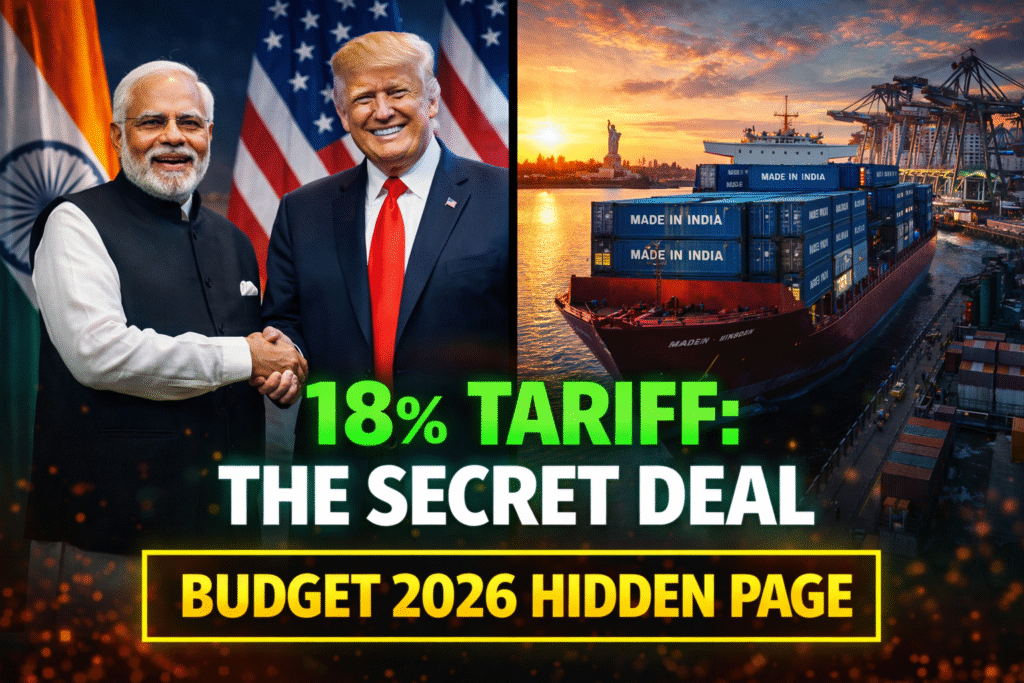
If you were watching the Budget 2026 speech and felt something was missing, you were right: the most explosive announcement was saved for 24 hours later. The truth is, while the Finance Minister was lowering customs duties on aircraft parts and nuclear equipment, the stage was being set for a historic phone call between PM Modi and President Trump that has now slashed US tariffs on Indian goods from a bruising 25% to just 18%.
The Shocking Blueprint: Why the Budget Was a “Gift” to Washington
Dalal Street was initially confused by several “one-sided” concessions in the Union Budget 2026. Why would India give a Tax Holiday until 2047 to foreign data center companies? Why scrap duties on nuclear generation equipment and aircraft components?
Here is the catch: these weren’t random acts of generosity. They were the “Hidden Page” of a pre-planned trade deal. By addressing key American demands in the Budget, India secured the leverage needed to negotiate the 18% reciprocal tariff rate—a move that immediately makes “Made in India” products more competitive than those from Vietnam (19%) and Bangladesh (20%).
The Trade Deal Scorecard: Old vs. New 2026 Reality
| Trade Metric | The “Sunday” Status (Pre-Deal) | The “Monday” Reality (Post-Deal) | Net Impact for India |
| US Tariff on Indian Goods | 25% (Penal Rate) | 18% | 7% Lower Cost |
| Additional “Oil Penalty” | +25% (for Russian Crude) | WAIVED | Massive Export Relief |
| India’s Energy Source | Russia (Top Supplier) | USA & Venezuela | Geopolitical Alignment |
| India’s Purchase Plan | Negotiating | $500 Billion Commitment | Long-term Trade Surplus |
How the 18% Tariff Move Was “Pre-Planned” Behind Closed Doors
The suddenness of the Monday evening announcement was an illusion. The “Common Man” might think this happened overnight, but the blueprint was laid out as early as February 2025.
- The Energy Pivot: India has agreed to stop purchasing Russian oil, a move that President Trump explicitly linked to the withdrawal of the 25% penal tariff. In exchange, India will buy over $100 billion in American energy and agriculture.
- The Budget 2026 Setup: By eliminating duties on aircraft MRO (Maintenance, Repair, and Overhaul) and nuclear parts on Sunday, India cleared the path for US aerospace and energy giants to enter the market.
- Data Sovereignty for Trade: The 2047 tax holiday for data centers was the “sweetener” that convinced Washington to lower the reciprocal tariff to 18%, giving Indian textile and leather exporters a sudden ₹2,000 Crore advantage over regional rivals.
What the Analysts Are Saying
The reaction from the market has been nothing short of a “Gold Rush” for export-oriented stocks.
- Goldman Sachs & JP Morgan: Analysts are calling this the “Great Re-rating.” They expect India’s export share in the US market to jump by 3-4% within the next fiscal year.
- Sector Experts: Leather and Textile stocks (like KPR Mill and Welspun) surged up to 20% in a single session. “The removal of the 25% penalty is a life-saver for the MSME sector,” says a lead economist at Elara Capital.
- The Consensus: This wasn’t a “capitulation” but a strategic swap—trading energy sources for market access.
Pro-Tip: Watch the “Energy Transition” Stocks
Don’t just watch the exporters. Watch Indian oil marketing companies (OMCs) like BPCL and HPCL. As they pivot from Russian Urals to American WTI crude, their shipping and refining margins will fluctuate. The real winners will be those with long-term US energy contracts.
The Bottom Line
The India-US Trade Deal is the second half of the Budget 2026 story. By cutting the reciprocal tariff to 18%, India has successfully dodged the “Trump Tariff” bullet that is currently hitting China and the EU. For the Retail Investor, the message is clear: the volatility of the STT hike is noise, but the opening of the American market to Indian goods is the real wealth creator of the decade.