
If you are an Indian exporter, your “Profit Margin” just received a massive injection of oxygen. The truth is, as of February 7, 2026, the punishing 50% “Oil-Penalty” Tariffs that were crushing Indian goods in the US market have been officially dismantled.
In a historic pivot, US President Donald Trump and PM Narendra Modi have finalized an Interim Trade Agreement that slashes general tariffs to 18% and, more importantly, creates a “Duty-Free” fast track for the sectors that power the Indian middle class.
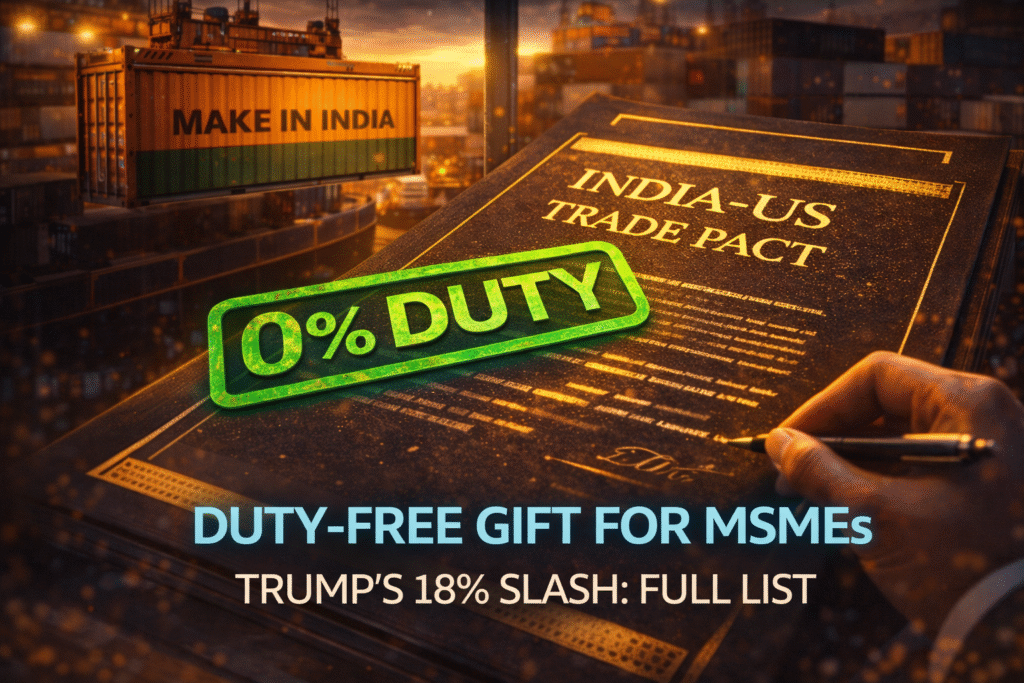
The Shocking Reset: From 50% to “Most Favored” Status
Just weeks ago, Indian exporters were struggling under a triple-layered tax: a 10% baseline, a 25% reciprocal tariff, and a 25% punitive duty linked to Russian oil purchases. Today, that wall has crumbled.
Why the sudden change? Here is the catch: India has committed to a $500 Billion purchase plan of US energy, aircraft, and technology over five years while pivoting away from Russian crude. In exchange, the US has rescinded all punitive duties, setting a new reciprocal cap of 18%—making Indian products more competitive than those from Vietnam, Bangladesh, and China.
The “Zero Duty” Winners: The Full Product List
While the general rate is 18%, Commerce Minister Piyush Goyal has confirmed a massive list of products that will now enter the US at 0% (Zero) Tariff:
| Category | Key Products Entering US at 0% Duty | Impact on MSMEs |
| Agriculture | Tea, Spices, Coffee, Cashew Nuts, Coconut Oil | Huge win for rural hubs |
| Fresh Produce | Mangoes, Bananas, Guavas, Avocados, Papaya | 100% margin recovery |
| Pharmaceuticals | Generic Drugs, Cancer & Heart medicines | $13 Billion market unlock |
| Luxury Goods | Gems, Diamonds, Gold Jewelry, Silk | Direct edge over China (34% tax) |
| Engineering | Aircraft Parts, Specific Auto Components | Precision manufacturing boost |
| Handicrafts | Artisanal products, Home Décor, Silk exports | Revival of traditional clusters |
How You Can Profit: The MSME “Secret Blueprint”
This deal isn’t just a political headline; it’s a manual for scaling your business. Here is how you can capitalize on the 18% Tariff Slash:
1. Re-Negotiate US Contracts Immediately
The tariff reduction is effective immediately. If you were offering discounts to US buyers to compensate for the old 50% duties, you now have a 32% price cushion. Use this to either increase your margins or undercut your Southeast Asian competitors by offering “Trade-Deal Specials.”
2. Leverage the “Make in India” Rules of Origin
To claim the 18% (or 0%) rate, your product must be certified as “Indian Origin.” This is your chance to shift your supply chain away from expensive Chinese raw materials. By sourcing locally, you not only meet the trade deal criteria but also become eligible for the ₹10,000 Crore technology upgrade fund mentioned in the Budget 2026.
3. Capitalize on the “GPU & Tech” Clause
The deal includes a massive “Power Move” for tech exports. India and the US will significantly increase trade in GPUs and AI hardware. If your MSME provides sub-components for data centers or AI systems, you are now part of a $500 billion priority supply chain.
What the Analysts are Saying
The consensus on Dalal Street is that the “Budget Gloom” has been replaced by “Export Euphoria.”
- Piyush Goyal (Commerce Minister): “This agreement will help India and the US remain focused on deepening economic cooperation. It is a milestone for our MSMEs and farmers.”
- Namit Joshi (Pharmexcil Chairman): “This represents a pivotal moment for the pharma sector. The U.S. market accounts for 30-40% of our revenue; zero duty is a game-changer.”
- The “Short-Squeeze” View: Market experts note that the 2,000-point Sensex jump last week was just the beginning. As FIIs (Foreign Institutional Investors) realize the scale of this “Duty-Free” gift, capital is expected to flood back into export-oriented mid-caps.
Also Read: Why and How the New India-US GPU Deal is a Shocking “Power Move” for India’s AI Future
Pro-Tip: The “SPS” Quality Barrier
Lower tariffs do not mean lower standards. The US is keeping strict Sanitary and Phytosanitary (SPS) measures. If you are in the food or pharma sector, invest your “tariff savings” back into FDA-grade certification to ensure your shipments aren’t held at the port.
The Bottom Line
The India-US Trade Deal is the “Real” Budget winner for 2026. By trading energy sourcing for market access, the government has given Indian MSMEs a “Duty-Free” gift that will define the next decade of growth. Whether you are selling silk from Varanasi or software from Bengaluru, the 18% cap is your invitation to the world’s largest consumer market.